

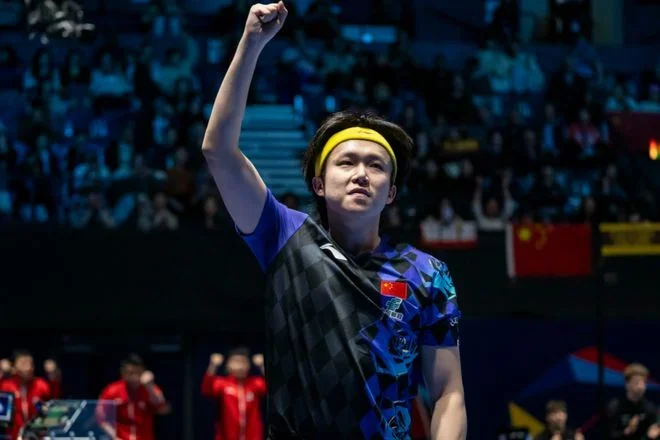
Wang Chuqin’s call is a positive step in correcting the unhealthy fan culture in sports.

▲ On May 6, Chinese team player Wang Chuqin celebrates a point during the match. Photo by Xinhua
By Liushui
Wang Chuqin spoke out early in the morning to say no to intrusive fan culture.
At 3 a.m. on May 8, while competing in the World Table Tennis Championships in London, Wang posted: “Hello everyone. Regarding my upcoming birthday, I do not encourage nor will I participate in any form of birthday support activities. Just watch the matches and cheer for the Chinese team. That’s the best support you can give me.”
Ahead of his 26th birthday, Wang’s clear and restrained message not only upholds the spirit of sportsmanship but also sets an example for the fight against toxic fan behavior in the sports world.
The “fan culture” in sports has been growing increasingly problematic, with birthday celebrations for athletes becoming almost routine. Big screens in shopping malls, drone shows, and fireworks have turned athletes’ birthdays into spectacles for clout and attention. For high-profile athletes with large followings, this often leads to offline stalking, online fan wars, and other disruptive behavior. Such actions stray far from the original intention of supporting athletes and undermine the purity of sports.
Wang Chuqin’s statement is a deliberate break from this trend. Last year, he mentioned in an interview that he doesn’t care much about birthday celebrations, placing more value on continuous progress and surpassing himself as an athlete. Now, he further emphasizes “focusing on the matches,” anchoring his value on the competition court. This clarity allows him to resist the lure of online popularity and keep his energy on honing his skills.
Wang’s stance is not isolated. Other top Chinese table tennis players like Fan Zhendong and Sun Yingsha have also called for rational fan behavior. The General Administration of Sport of China and the Chinese Table Tennis Association have clearly opposed irrational idolization around athletes. These efforts reflect the national team’s vigilance against fan culture and the athletes’ consensus on maintaining professional boundaries.
The beauty of sports lies in the courage to push limits, the perseverance to never give up, and the principle of fair competition – not in fan rivalry or spectacle.
Compared to traditional sports audiences, “fan culture” may still express “support,” but its methods and focus often cross the line. Whether it’s athletes being mobbed by paparazzi or fans sneaking into hotel rooms, such actions not only disturb athletes and disrupt their training but also violate the spirit of sports.
Some fans might want to find ritualistic ways to show their “love.” Even so, they need to find a fitting way that makes the “love” mutual, not a one-sided disruption.
Notably, Wang Chuqin stated, “I do not encourage nor will I participate.” “Not participate” is a self-restriction; “not encourage” is a clear message to fans. Wang’s appeal serves as a positive guidance for reforming fan culture in sports.
Fans should heed this advice, understand Wang’s true intention, and move away from superficial support rituals. Instead, they should direct their attention to the matches, embrace wins and losses with a more inclusive mindset, and protect the purity of sport with rational love. Letting athletes focus wholeheartedly on preparation and competition is the most lasting and sincere form of support.
Written by / Liushui (Media Professional)
Edited by / Ma Xiaolong
Proofread by / Chen Diyan

