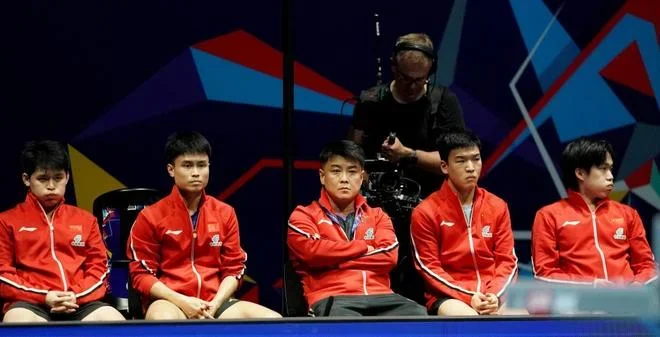

The Chinese men’s table tennis team has stumbled into two consecutive defeats in the group stage of the 2026 London World Team Championships. After falling 1-3 to South Korea, ending a 26-year unbeaten streak in team events since the 2000 Kuala Lumpur World Championships, they lost a grueling five-set battle against Sweden 2-3 the following day, leaving them with a 1-2 record in group play.
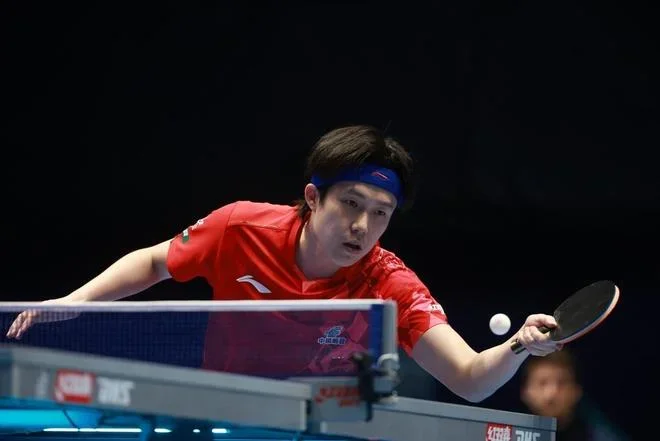
The silver lining is that these losses do not affect China’s seed or draw in the knockout rounds. The darker truth, however, is that this performance is a stark reflection of the team’s current strength rather than a mere upset.
When Lin Shidong and Liang Jingkun dropped points repeatedly, cameras inevitably focused on Wang Chuqin. The English commentary was blunt: “This is China’s young captain, and the weight is on his shoulders.”
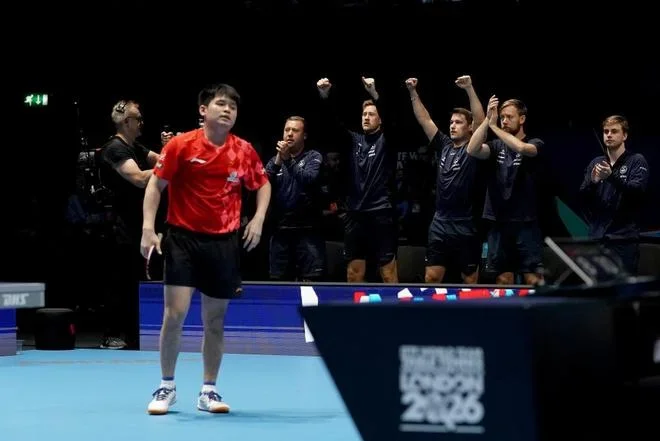
Against both South Korea and Sweden, China struggled to find a reliable second scorer beyond Wang. Opponents cleverly adjusted their lineups—South Korea rested top player Jang Woo-jin, while Sweden placed world No. 2 Truls Möregårdh at the third singles spot. These tactical shifts caught the Chinese team off guard.
Lin Shidong lost to Korea’s Oh Junsung, then fell to Sweden’s Elias Ranefur (world No. 70), and also lost to Anton Källberg, suffering three defeats in the tournament. Liang Jingkun similarly struggled, losing to Oh Junsung and Möregårdh. Ranefur explained after his match: “My playstyle is quite unique. I create trouble with speed and spin on serves, especially against opponents who haven’t faced me before—they often find it hard to adapt.” In practice, Lin was forced into a passive role.
More worryingly, the lineup against Sweden represented China’s strongest possible formation. Lin Shidong is the second-highest ranked player behind Wang, and Liang Jingkun is the most experienced member of the squad. If neither can consistently deliver points, it’s difficult for China to collect the three wins needed.
Looking back over recent months, London’s stumble is not a random “black swan” event but a symptom of a long-simmering issue. At the recent Macau World Cup, only Wang Chuqin among five Chinese men’s singles players reached the quarterfinals. Earlier, at the Asian Cup and Singapore Smash, Wang was the sole Chinese presence in the semifinals. A brutal fact: since the 2025 WTT Singapore Smash, Wang has won all Chinese men’s singles titles at WTT Champions-level events and above; in tournaments he didn’t win, the titles went to foreign players.
This explains why Japan’s Sora Matsushima confidently stated before the World Championships that Japan’s winning probability had risen from under 10% at the previous edition to 30%. With the depth of the Chinese men’s team thinning, the competition for the championship in this centennial World Championships is far more open than imagined.
Fortunately, the two group-stage losses did not worsen China’s knockout draw. Qualifying as the third seed from the group, China landed in the lower half and will face Australia in the first round. Their main rivals in this half are South Korea and France. Compared to the stacked upper half featuring Sweden, Denmark, Chinese Taipei, Germany, and Japan, China’s path is relatively manageable. Whether the team can rebound depends on the coaching staff’s adjustments and the players’ ability to recover.
It’s undeniable that the Chinese team is enduring the pains of transition. After the Paris Olympics, with the retirement of core veteran Ma Long and the withdrawal from world rankings of Fan Zhendong, the men’s team has been forced into a difficult period of generational change. The common law of competitive sports is that the collective departure of multiple top players from one era inevitably creates a gap in player reserves and mental resilience that is hard to fill in the short term—even for China.
This World Championships marks the second time in the 21st century that China has fielded a men’s team roster with two non-world champions. The first time was at the 2000 Kuala Lumpur World Championships.
But this challenge is more severe than ever. On one hand, the collective surge of foreign players is unprecedented: Japanese and Korean rising stars as well as European powerhouses like Sweden’s Möregårdh are closing the technical gap, and their confidence in trying to beat China is quietly growing. On the other hand, young Chinese players still need to polish their mentality under pressure—they show obvious weaknesses in handling crucial points.
As coach Liu Guozheng said after the defeats: “The team has no retreat and no room for luck. We have to rely on our own ability to break through this difficulty. The tournament isn’t over, and everything is still possible.”